Quick answer (as of November 2026): To get permanent residency in Canada, you apply through a program that fits your profile, such as Express Entry, a Provincial Nominee Program or family sponsorship. Economic programs usually ask for skilled work experience, language test results and education proof. Once invited or approved, you complete medicals and checks, then confirm your PR.
If you’re reading this, you’ve probably typed some version of “how to get permanent residency in Canada” into Google more than once. Maybe you’re on a work permit and your end date is getting closer. Maybe you’re abroad and wondering if Canada is still realistic. Either way, the official information is spread across dozens of pages, and it’s easy to feel lost.
This guide puts it in one place. You’ll learn what PR actually means, how many people Canada plans to accept, the main programs, the steps from start to finish, and the mistakes that cause refusals. We’re a licensed RCIC firm in Waterloo, Ontario, and we’ve written it the way we’d explain it across the table.
What is permanent residency in Canada?
A permanent resident (PR) is someone who has been given the right to live in Canada permanently but isn’t a Canadian citizen yet. As a permanent resident, you can:
- Live, work or study anywhere in Canada
- Get most social benefits, including health care coverage
- Apply for Canadian citizenship once you meet the requirements
There are limits. Permanent residents can’t vote or run for office, and you must live in Canada for at least two years (730 days) within every five-year period to keep your status.
How many permanent residents will Canada accept?
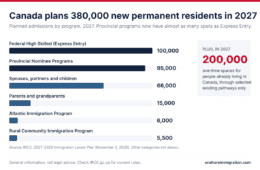
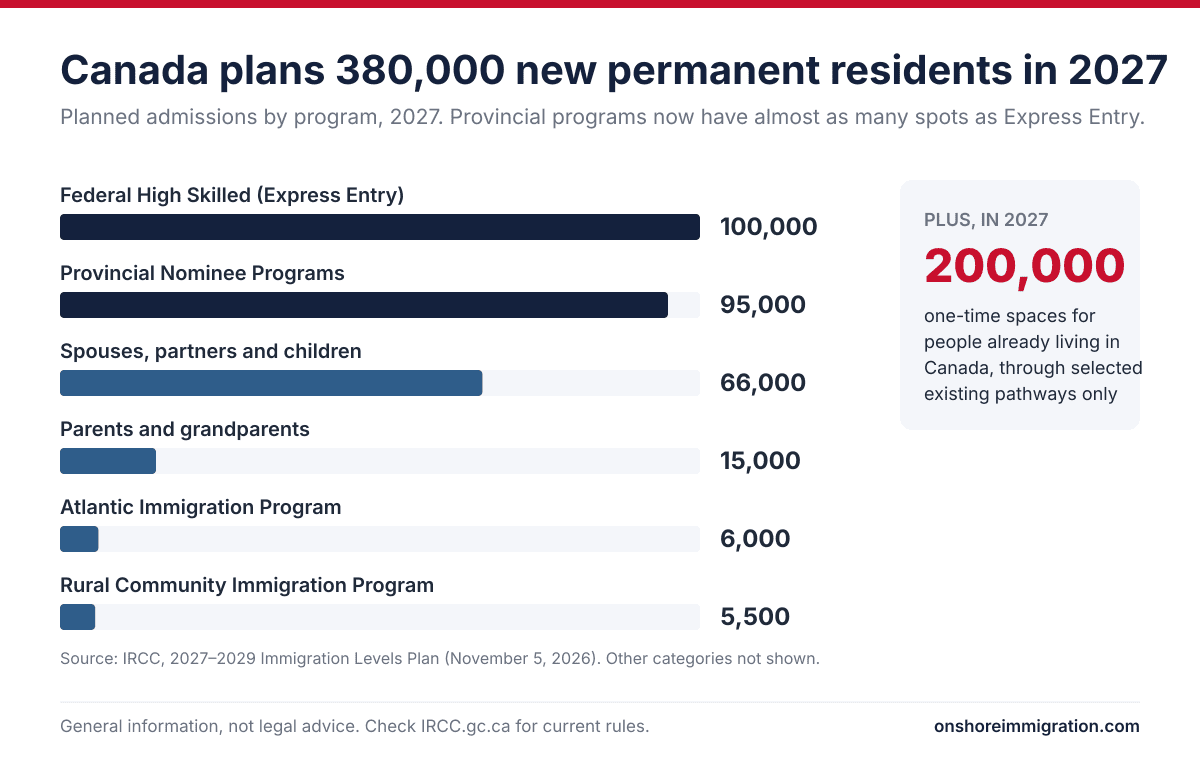
On November 5, 2026, the government released its 2027–2029 Immigration Levels Plan. It keeps Canada’s target at 380,000 new permanent residents a year. Here’s how some of the key programs are planned for 2027:
| Program or category | 2027 target |
|---|---|
| All new permanent residents | 380,000 |
| Federal High Skilled (Express Entry programs) | 100,000 |
| Provincial Nominee Programs | 95,000 |
| Spouses, partners and children | 66,000 |
| Parents and grandparents | 15,000 |
| Atlantic Immigration Program | 6,000 |
| Rural Community Immigration Program | 5,500 |
Two things stand out. First, provincial programs now have almost as many spots as Express Entry, so the province you choose matters more than ever. Second, a separate one-time measure adds room for up to 200,000 people already living in Canada in 2027. It mainly speeds up applications already in IRCC’s queue under selected pathways. It is not a new program anyone can apply to.
Want the bigger picture behind these numbers? Read our guide to Canada’s post-boom immigration reset.
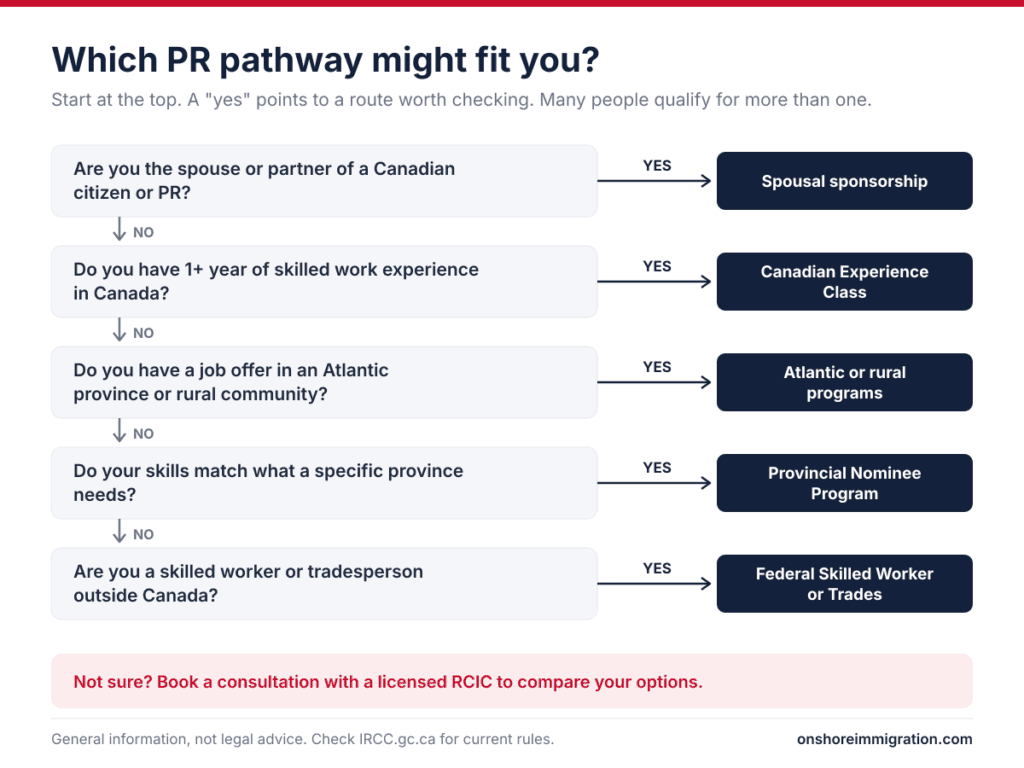
The main ways to become a permanent resident in Canada
There’s no single “PR application.” You become a permanent resident through a specific program. Here are the main ones.
Express Entry
Express Entry is an online system that manages three federal programs:
- Canadian Experience Class: for skilled workers with Canadian work experience
- Federal Skilled Worker Program: for skilled workers, often from outside Canada
- Federal Skilled Trades Program: for qualified tradespeople
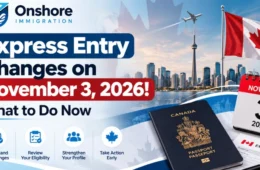
You create a profile, get a Comprehensive Ranking System (CRS) score, and wait for an invitation to apply. Since November 3, 2026, Express Entry gives extra points for Canadian work experience or a job offer in a high-wage occupation. Our post on the Express Entry changes in November 2026 explains how the new points work.
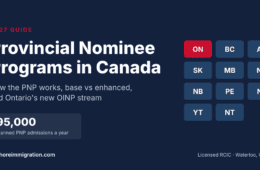
Provincial Nominee Programs (PNPs)
Most provinces and territories can nominate people who fit their local job market. Some streams link to Express Entry, and a provincial nomination adds a large number of CRS points. Others run outside Express Entry. If you want to live in Ontario, start with the Ontario Immigrant Nominee Program. You can also explore other provincial programs, such as Manitoba and Nova Scotia.
Family sponsorship
Canadian citizens and permanent residents can sponsor a spouse or common-law partner, dependent children and, when intake is open, parents and grandparents. The sponsor must meet their own requirements, and the relationship must be genuine.
Atlantic and rural programs
The Atlantic Immigration Program and the Rural Community Immigration Program help employers in smaller communities hire and keep workers. Both usually need a job offer from an approved employer. The rural program has now been made permanent.
Other routes
There are also humanitarian and refugee pathways, and Quebec runs its own selection system. These have very different rules, so get advice that’s specific to your case.
| Pathway | Often a good fit for | Job offer needed? |
|---|---|---|
| Canadian Experience Class | Skilled workers with at least 1 year of Canadian experience | No |
| Federal Skilled Worker | Skilled workers abroad with strong language and education | No, but it can help |
| Federal Skilled Trades | Qualified tradespeople | A job offer or a Canadian trade certificate |
| Provincial Nominee Program | People with skills a province needs | Depends on the stream |
| Spousal sponsorship | Partners of Canadian citizens or PRs | No |
| Atlantic or rural programs | People hired by employers in those regions | Yes |
How to become a permanent resident in Canada: step by step
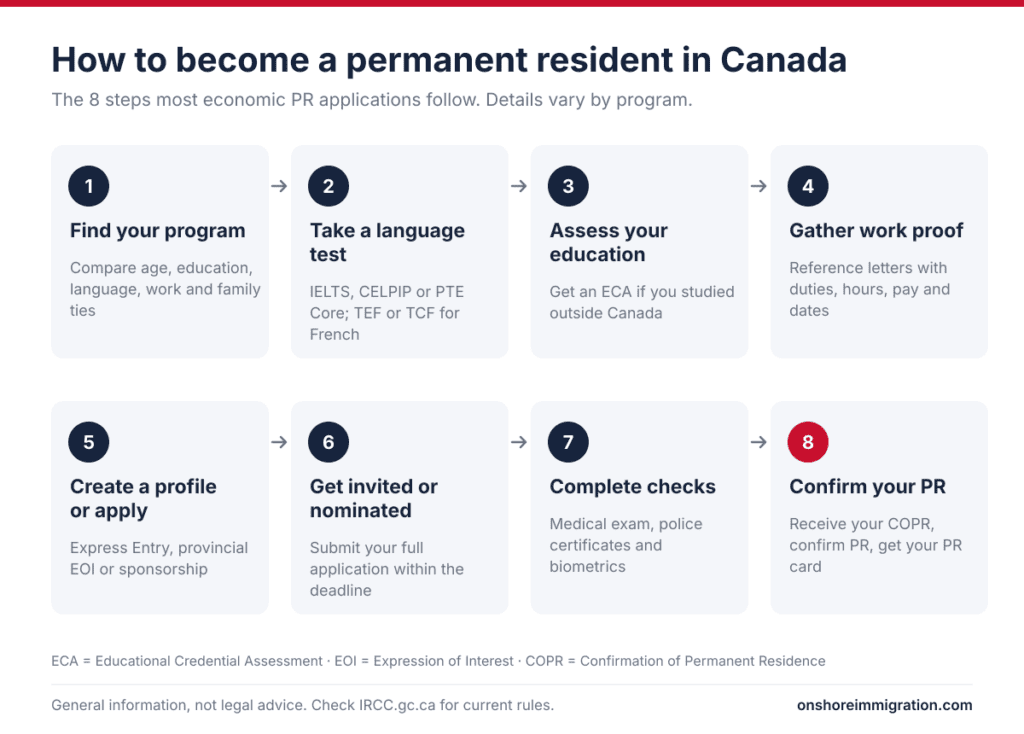
The details change by program, but most economic applications follow this order:
- Find the program that fits. Compare your age, education, language, work history and family ties against each program. A licensed RCIC can do this with you.
- Take an approved language test. For English, that’s IELTS General Training, CELPIP-General or PTE Core. For French, it’s TEF Canada or TCF Canada.
- Get your education assessed. If you studied outside Canada, you’ll usually need an Educational Credential Assessment (ECA).
- Collect proof of your work. Reference letters should list your duties, hours, pay and dates. Keep pay stubs and tax slips too.
- Create a profile or apply. That might be an Express Entry profile, a provincial expression of interest or a sponsorship application.
- Get invited or nominated. In Express Entry, you’ll receive an invitation to apply (ITA). You then have a limited time, currently 60 days, to submit everything.
- Submit your full application. Add police certificates, a medical exam with an approved panel physician, biometrics and, if needed, proof of funds. Pay the government fees.
- Get your decision and confirm PR. If approved, you’ll receive a Confirmation of Permanent Residence (COPR). You then confirm your PR online or when you enter Canada, and your PR card is mailed to you.
Permanent resident requirements for Canada: the basics
Every program has its own rules, but most applications are judged on some mix of these:
- Language: test results that meet the program’s minimum
- Education: proof of your highest degree or diploma, plus an ECA if you studied abroad
- Work experience: usually skilled work (TEER 0, 1, 2 or 3) for economic programs
- Settlement funds: proof you can support yourself and your family, for some programs
- Admissibility: a medical exam, police certificates and complete, honest answers
- Intent: for provincial programs, a real plan to live in that province
How long does it take?
It depends on the program. IRCC aims to process most Express Entry applications in about six months after you submit. Provincial, family and other programs often take longer. IRCC updates its processing times often, so check its online tool for current estimates.
The biggest delay we see isn’t IRCC’s speed. It’s going back and forth over missing or unclear documents.
Common mistakes that slow down or sink a PR application
- Choosing the wrong occupation code. IRCC looks at your duties, not your job title.
- Letting documents expire. Language tests, police certificates and passports all have expiry dates.
- Leaving gaps unexplained. Unaccounted months in your history raise questions.
- Inconsistent information. Your PR application should match what you’ve told IRCC before, including on study and work permit applications.
- Paying for a job offer. Buying or faking an offer is misrepresentation and can lead to a five-year ban.
- Trusting unlicensed “agents.” Anyone you pay for immigration advice must be authorized. Our guide on how to check a consultant before you pay shows you how.
After you become a Canadian permanent resident
Getting PR is a huge milestone, but a few things continue:
- Keep your status. Spend at least 730 days in Canada in every five years.
- Renew your PR card. It usually lasts five years, and you’ll need a valid one to re-enter Canada by plane.
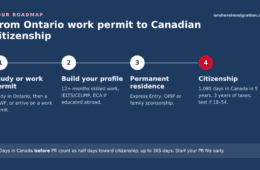
- Plan for citizenship. Once you’ve lived in Canada long enough as a PR, you can apply to become a citizen. Our Canadian citizenship application guide covers the requirements and timeline.
How Onshore Immigration can help
Applying for PR is one of the biggest decisions of your life, and it’s normal to feel nervous about getting it wrong. You don’t have to work it out alone.
We’re a Canada-based firm with a licensed RCIC regulated by the College of Immigration and Citizenship Consultants (CICC). From our Waterloo office, or by phone or video, we can:
- Review your profile and tell you honestly which programs look realistic
- Build a document checklist for your exact situation
- Prepare and review your application before it’s submitted
We can’t promise an approval or a timeline, because only IRCC decides. What we can do is help you choose the right route and build a strong, complete application. Learn more about our permanent residence services.
Call: +1 548 255 1725 · Email: support@onshoreimmigration.com
Office: 180 Northfield Dr W Unit 4, Waterloo, ON N2L 0C7, Canada (please book before you visit)
Frequently asked questions
How do I get permanent residency in Canada?
Choose an immigration program you qualify for, such as Express Entry, a Provincial Nominee Program or family sponsorship. Gather your language test results, education assessment and work proof. Apply or create a profile, wait for an invitation or approval, then complete medicals, biometrics and police checks before confirming your PR.
How do I become a permanent resident in Canada from inside Canada?
Many people become permanent residents from inside Canada after working or studying here. The Canadian Experience Class under Express Entry is common for skilled workers with at least one year of Canadian experience. Provincial programs and in-Canada spousal sponsorship are other options. Keep your current status valid while you wait.
Can I become a Canadian permanent resident without a job offer?
Yes, it’s possible. Many Express Entry candidates are invited without a job offer, and many provincial streams don’t require one either. Without an offer, your score depends more on age, education, language results and work experience. Strong language scores and French ability can make a real difference to your chances.
What is the easiest way to get PR in Canada?
There’s no single easiest way. The best route depends on your age, education, language scores, work history, family ties and where you want to live. For workers already in Canada, the Canadian Experience Class is often a strong option. For others, a provincial program may fit better. An honest assessment helps.
How long does it take to get PR in Canada?
It depends on the program. IRCC aims to process most Express Entry applications in about six months after you submit. Provincial nominee, family and other programs often take longer. Check IRCC’s processing times tool for current estimates, since they change often. A complete application helps avoid extra delays.
How many permanent residents will Canada accept in 2027?
Under the 2027–2029 Immigration Levels Plan released on November 5, 2026, Canada aims to admit 380,000 new permanent residents in each of 2027, 2028 and 2029. A separate time-limited measure adds space for up to 200,000 people already in Canada in 2027, through selected existing pathways.
Can I apply for PR myself, or do I need a consultant?
You can apply yourself. IRCC doesn’t require a representative, and it treats all applications the same way. Many people choose a licensed RCIC or lawyer when their case is complex, they’ve been refused before, or they want a second check. If you pay anyone for advice, confirm their licence first.
Is there an immigration consultant in Waterloo who helps with PR?
Yes. Onshore Immigration Services Inc. is at 180 Northfield Dr W, Unit 4, Waterloo, and helps clients across Waterloo, Kitchener, Cambridge, Guelph and Ontario with PR applications. You can meet us in person or by phone or video. Book a consultation online or call +1 548 255 1725.
Ready to find your path to Canadian PR? Book a 30-minute consultation with our Waterloo RCIC.