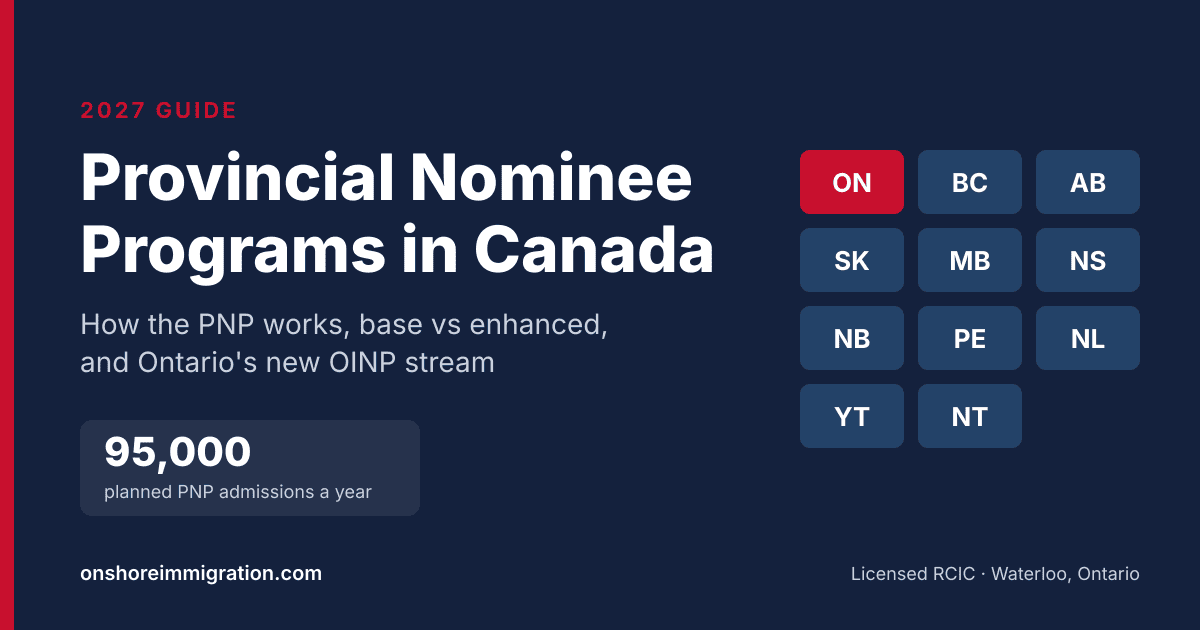
Quick answer (as of November 2026): The Provincial Nominee Program (PNP) lets Canadian provinces and territories choose immigrants who fit their local job market. If a province nominates you, you then apply to IRCC for permanent residence. Canada plans 95,000 PNP admissions a year from 2027 to 2029, almost as many as Express Entry.
If your Express Entry score feels stuck, or your job offer is in a province you’d love to call home, the Provincial Nominee Program might be the route you’ve been missing.
It’s also one of the most confusing parts of Canadian immigration. Each province runs its own streams, with its own rules, and those rules change often. Ontario alone replaced eight streams with one in 2026.
This guide explains how the provincial nominee program in Canada works, the difference between base and enhanced nominations, what each province looks for, and how to pick a stream that fits. We’re a licensed RCIC firm in Waterloo, Ontario, and we wrote this the way we’d explain it in a consultation.
What is the Provincial Nominee Program?
The Provincial Nominee Program, or PNP, is a way for provinces and territories to choose newcomers who meet their own economic needs. A province might need nurses, truck drivers, tech workers or people willing to settle outside big cities.
The process has two parts:
- The province decides whether to nominate you. It checks you against its stream’s rules and local needs.
- IRCC decides whether to grant permanent residence. It checks your medical, security and criminal background, and confirms your application is complete and truthful.
A nomination is a big step, but it isn’t PR on its own. Both parts have to go right.
Who runs a PNP? Most provinces and territories do. Quebec doesn’t: it selects its own immigrants through separate programs. Nunavut doesn’t run one either.
Why the PNP matters more than ever in 2027
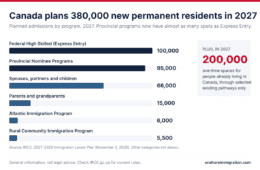
Under the 2027–2029 Immigration Levels Plan released on November 5, 2026, Canada plans to admit 95,000 permanent residents through provincial programs in each of 2027, 2028 and 2029. That’s close to the 100,000 planned for Express Entry’s federal programs.
The government also announced a one-time measure for 2027 that gives provinces extra nomination space to help workers already in Canada become permanent residents. This isn’t a new application stream. Provinces decide how to use the extra space, and they pick candidates through their own programs.
In short: where you live and work in Canada now affects your PR chances almost as much as your CRS score.
For the bigger picture, see our guide on how to get permanent residency in Canada.
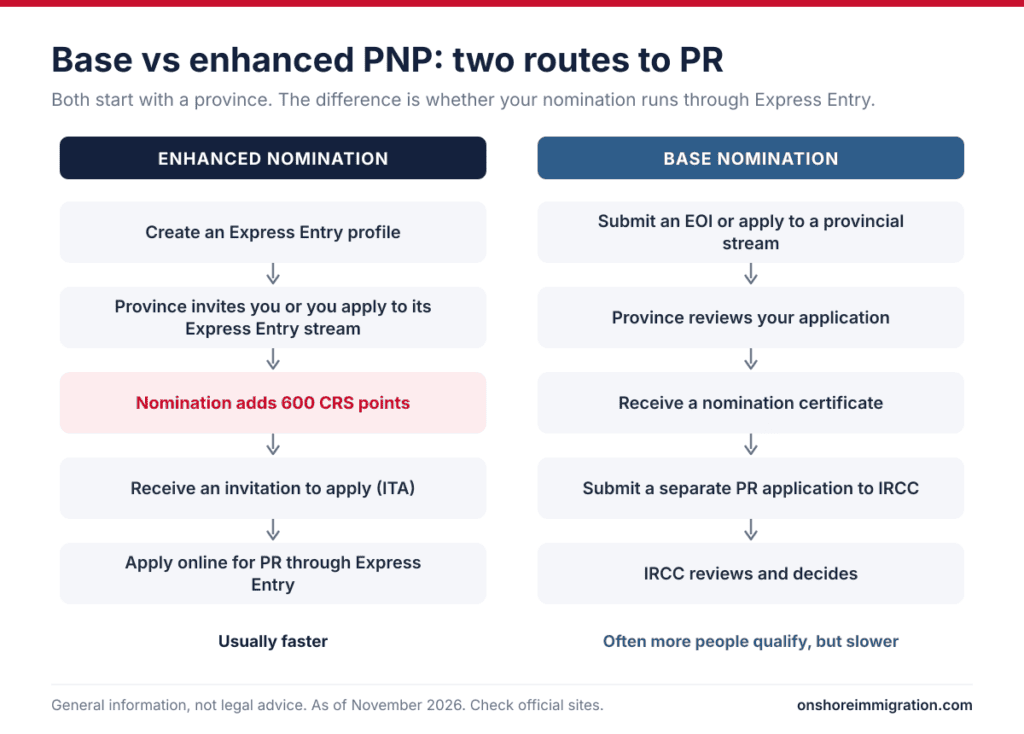
Base vs enhanced nominations: the key difference
Every PNP stream falls into one of two types. Knowing which one you’re in changes the whole process.
| Enhanced nomination | Base nomination | |
|---|---|---|
| Linked to Express Entry? | Yes | No |
| Do you need an Express Entry profile? | Yes, and you must qualify for a federal program | No |
| What the nomination gives you | 600 extra CRS points | The right to apply to IRCC for PR |
| How you apply to IRCC | Online through Express Entry, after an invitation | A separate PR application |
| Processing speed | Usually faster | Usually slower |
| Who it often suits | Skilled workers already in the Express Entry pool | People who don’t qualify for Express Entry, including some lower-skilled jobs |
That 600-point boost is why an enhanced nomination matters so much. Under the CRS changes that took effect on November 3, 2026, it still adds 600 points, which puts almost any candidate above the cut-off for PNP draws. Read our post on the Express Entry changes in November 2026 to see how the new points system works.
How the PNP process works, step by step
The details change by province and stream, but most applications follow this path:
- Pick a province and stream. Match your job, skills and plans to a stream’s rules.
- Submit an expression of interest (EOI) or apply directly. Most provinces now use an EOI system, where you create a profile and get a score.
- Receive an invitation. The province invites the highest-scoring or best-matched candidates in a draw.
- Apply to the province. Send your documents and pay the provincial fee, if there is one.
- Get nominated. If approved, you receive a nomination certificate (base) or a nomination in your Express Entry profile (enhanced).
- Apply to IRCC for PR. Submit your PR application with medicals, police certificates and biometrics.
- Get your decision. If approved, you confirm your PR and move to, or stay in, your nominating province.
PNP requirements: what provinces usually look for
There’s no single list of PNP requirements. Each stream sets its own. Most look at some mix of:
- A job offer from an employer in the province, often full-time and permanent
- Work experience, either in the province or in an in-demand occupation
- Language test results that meet the stream’s minimum
- Education, sometimes a degree or diploma from a school in that province
- Ties to the province, such as past study, work or family there
- Settlement funds, for some streams without a job offer
- A genuine plan to live there after you become a permanent resident
That last point is important. A provincial nomination is given on the understanding that you’ll settle in that province. Saying you’ll live somewhere you don’t plan to live can be treated as misrepresentation.
Ontario’s PNP (OINP) in 2026: what changed
If you live in Waterloo, Kitchener, Cambridge or anywhere else in Ontario, this section matters most to you.
In June 2026, Ontario redesigned the Ontario Immigrant Nominee Program. It closed eight streams, including the Employer Job Offer streams, the Masters and PhD Graduate streams, and the three Express Entry streams (Human Capital Priorities, French-Speaking Skilled Worker and Skilled Trades).
They were replaced by one new stream: the Ontario Workforce Priority stream. As of November 2026, it has three pathways:
- A job offer in a TEER 0–3 occupation (higher-skilled jobs)
- A job offer in a TEER 4–5 occupation (other jobs)
- Eligible self-employed physicians, without a job offer
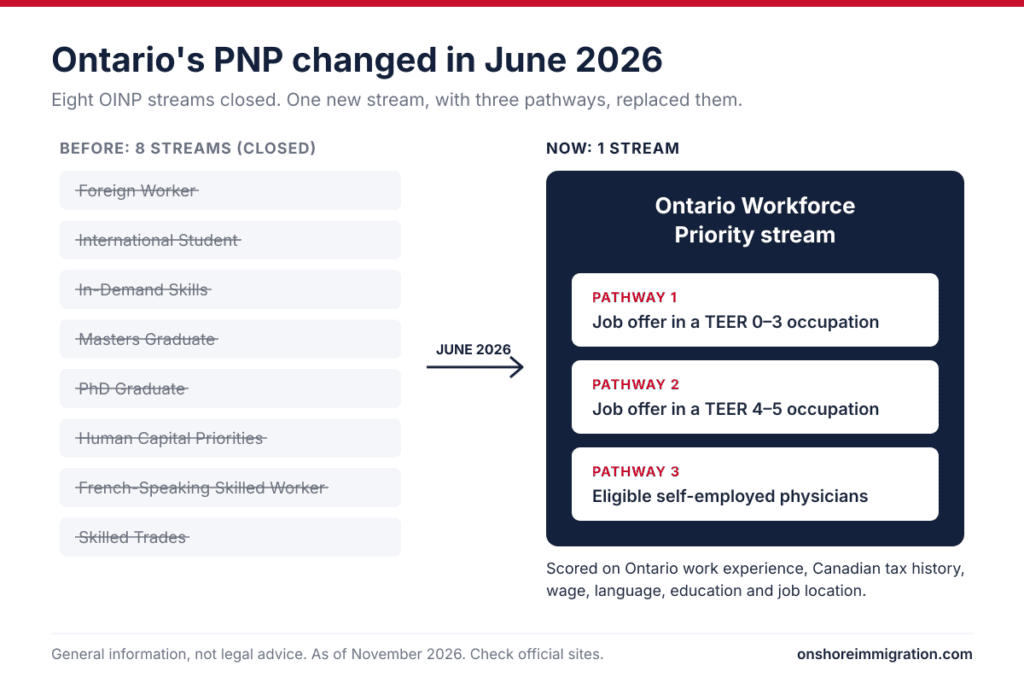
Here’s how it works in practice. Your employer first submits the job offer through Ontario’s employer portal. You then register an EOI, which is scored on things like Ontario work experience, Canadian tax history, wage, language ability, education and job location. Jobs outside Toronto can earn extra points.
What this means for you:
- A job offer is now central for almost everyone applying through Ontario
- Ontario experience counts heavily, which helps people already working here
- Graduates no longer have a stream of their own, so many will need a job offer or Express Entry instead
- Ontario says more changes are coming in a second phase, so check before you apply
Learn more about our help with the Ontario Immigrant Nominee Program.
Other provincial programs at a glance
Every province has its own focus. Here’s a simple overview. Streams change often, so treat this as a starting point.
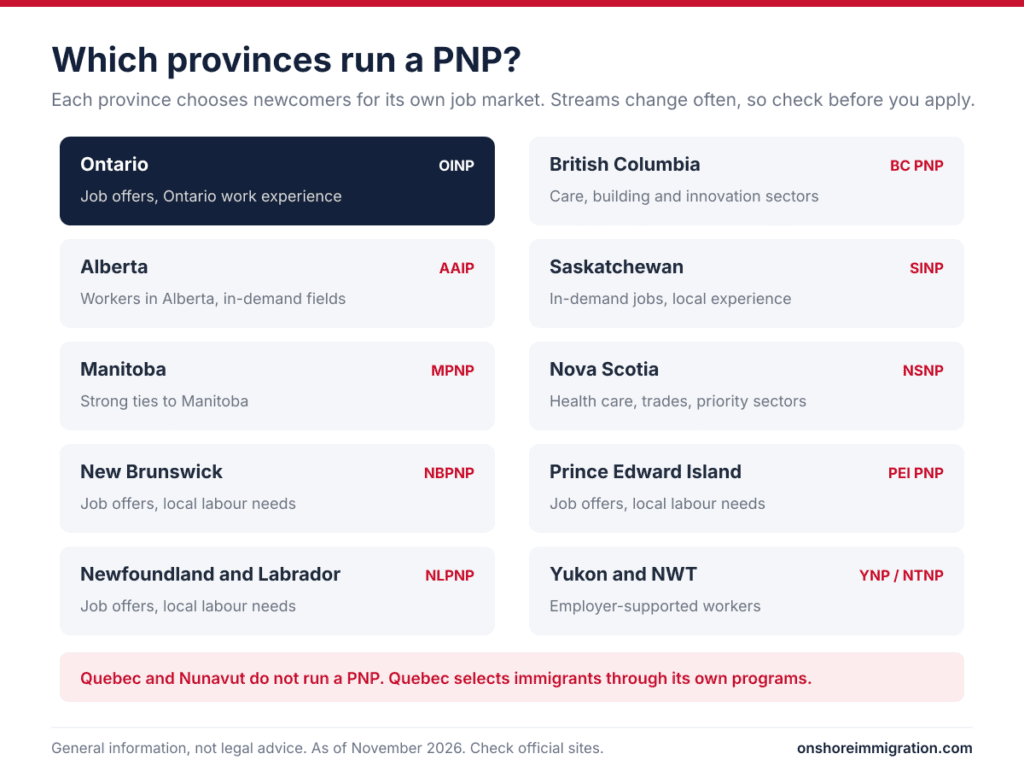
| Province or territory | Program | Often looks for |
|---|---|---|
| Ontario | Ontario Immigrant Nominee Program (OINP) | Job offers, Ontario work experience |
| British Columbia | BC Provincial Nominee Program | Workers in care, building and innovation sectors |
| Alberta | Alberta Advantage Immigration Program | Workers in Alberta and in-demand fields |
| Saskatchewan | Saskatchewan Immigrant Nominee Program | In-demand occupations, Saskatchewan experience |
| Manitoba | Manitoba Provincial Nominee Program | Workers and graduates with strong ties to Manitoba |
| Nova Scotia | Nova Scotia Nominee Program | Workers in health care, trades and other priority sectors |
| New Brunswick, PEI, Newfoundland and Labrador | Their own PNPs, plus the Atlantic Immigration Program | Job offers and local labour needs |
| Yukon and Northwest Territories | Their own nominee programs | Employer-supported workers |
Want to look at a specific province? See our pages on the Manitoba Provincial Nominee Program, the Nova Scotia Nominee Program and our PNP programs overview.
How to choose the right PNP stream
With so many options, it helps to ask a few honest questions:
- Where do you actually want to live? Pick a province you’d be happy to settle in, not just one with an open draw.
- Do you have a job offer? If yes, start with that province’s employer streams.
- Are you already in the Express Entry pool? Look at enhanced streams that can invite candidates from the pool.
- Do you have ties to a province? Past study or work there can open doors.
- Is your occupation in demand there? Many provinces run draws for specific jobs, such as health care or trades.
It’s normal for one person to qualify for more than one stream. Choosing the right one is often what makes the difference.
Costs and timelines
There are two sets of fees. Provincial fees vary by province and stream, and some streams charge nothing. IRCC then charges its own PR fees. As of November 2026, the federal fee for a principal applicant is about $1,590, including the right of permanent residence fee, plus $85 for biometrics.
Timelines vary a lot. Enhanced nominations usually move faster because the PR application goes through Express Entry. Base nominations often take longer, both at the provincial stage and at IRCC. Check IRCC’s processing times tool and your province’s site for current estimates.
Common PNP mistakes to avoid
- Relying on old information. Streams open, close and change every year. Ontario’s 2026 redesign is a good example.
- Picking a province you don’t plan to live in. This can be treated as misrepresentation.
- Letting your EOI or documents expire. Language tests, EOIs and permits all have end dates.
- Mismatched job details. Your job duties should match the occupation code you claim.
- Paying for a job offer. Buying a job offer is fraud and can lead to a refusal and a five-year ban.
- Using an unlicensed agent. Anyone you pay for advice must be authorized. Here’s how to check a consultant before you pay.
How Onshore Immigration can help
PNPs reward people who pick the right stream at the right time. That’s hard to do when the rules keep moving.
We’re a Canada-based firm with a licensed RCIC regulated by the College of Immigration and Citizenship Consultants (CICC), based in Waterloo, Ontario. We can:
- Compare your profile against provincial streams that fit
- Explain Ontario’s new Workforce Priority stream and whether it suits you
- Prepare your EOI, provincial application and IRCC PR application
We can’t promise a nomination or approval, because provinces and IRCC make those decisions. What we can do is help you choose wisely and submit a strong, complete application.
Frequently asked questions
What is the Provincial Nominee Program in Canada?
The Provincial Nominee Program lets provinces and territories choose immigrants who meet their local economic needs. If a province nominates you, you then apply to IRCC for permanent residence. Most provinces and territories run a PNP, but Quebec and Nunavut don’t. Each program has its own streams and rules.
What is the difference between a base and an enhanced nomination?
An enhanced nomination is linked to Express Entry. It adds 600 CRS points to your profile, which almost always leads to an invitation to apply. A base nomination works outside Express Entry, so you file a separate PR application with IRCC. Base streams can suit more people but usually take longer.
Do I need a job offer for a PNP?
Not always. Many streams need a job offer, especially in Ontario after its 2026 redesign. Other provinces have streams for in-demand occupations, graduates or Express Entry candidates that don’t need one. The answer depends on the province and the stream, so check the current rules before applying.
How many PNP nominees will Canada accept in 2027?
Under the 2027–2029 Immigration Levels Plan, released on November 5, 2026, Canada plans to admit 95,000 permanent residents through provincial nominee programs in each of 2027, 2028 and 2029. Each province’s own nomination allocation is set separately and may be announced later.
What happened to Ontario’s OINP streams in 2026?
In June 2026, Ontario closed eight OINP streams, including its Express Entry streams and graduate streams. It replaced them with the Ontario Workforce Priority stream, which has pathways for TEER 0–3 jobs, TEER 4–5 jobs and eligible self-employed physicians. Ontario says more changes are planned in a second phase.
Can I move to another province after getting PR through a PNP?
As a permanent resident, you have the right to live anywhere in Canada. But a provincial nomination is given because you intend to live in that province. If you never planned to settle there, IRCC may treat that as misrepresentation. Be honest about your plans from the start.
How long does the PNP process take?
It depends on the province and stream. Enhanced nominations usually move faster because the PR application goes through Express Entry. Base nominations often take longer at both the provincial and federal stages. Check your province’s website and IRCC’s processing times tool for current estimates.
Is there a PNP consultant in Waterloo, Ontario?
Yes. Onshore Immigration Services Inc. is at 180 Northfield Dr W, Unit 4, Waterloo, and helps clients in Waterloo, Kitchener, Cambridge, Guelph and across Ontario with provincial nominee applications. You can meet us in person or by phone or video. Call +1 548 255 1725 to book.